In the coming weeks, María José Etulain, founder of MJE Global, will participate in the Americas Food & Beverage Show in Miami, a meeting place for producers, manufacturers and suppliers of food from the United States and other international markets.
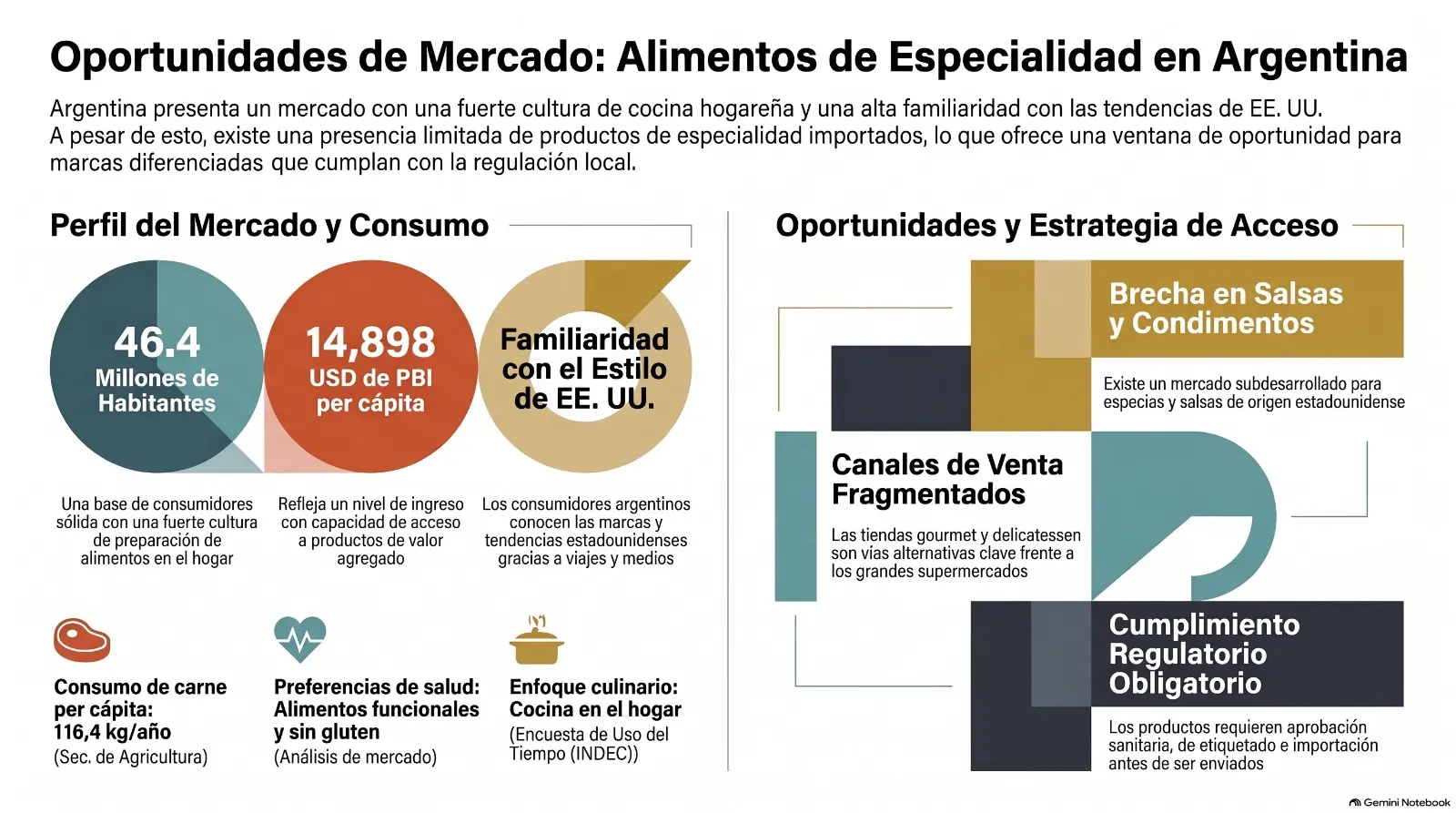
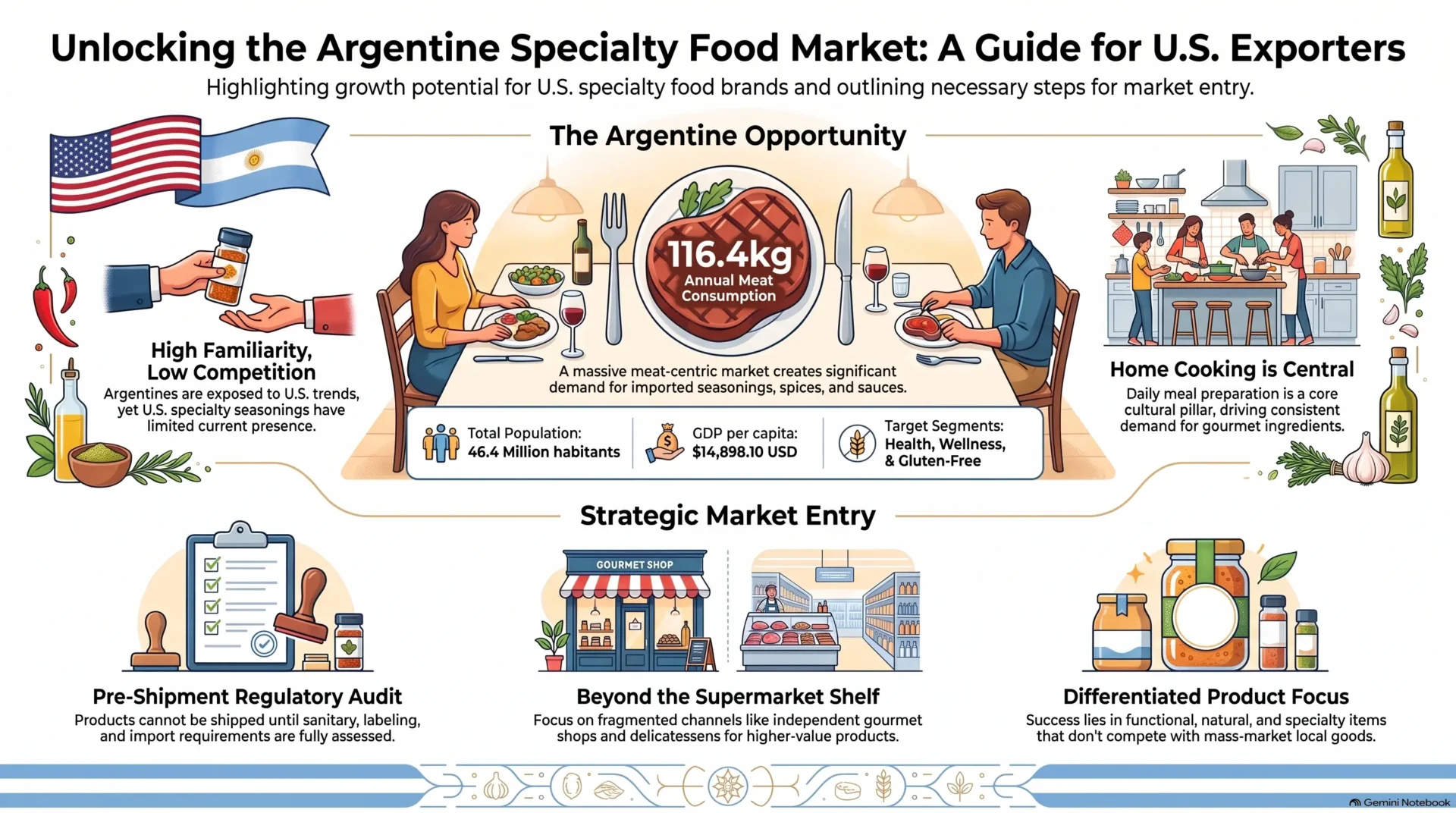
As part of that participation, we shared an overview of the Argentine food and beverage market — designed for US exporters evaluating whether, how, and when to enter this market.
Argentina has a consolidated domestic consumer market, with an imported brand offering still fragmented across several categories. For a US exporter, this combination—real demand and limited competition—usually translates into a concrete window of opportunity, provided that entry is planned with the same rigor as any other regulated market.
Evaluating that income involves reviewing, among other factors, the most appropriate distribution channel, the applicable regulatory and health requirements, and the current tariff structure for each product category.
Are you considering exporting food or beverages to Argentina?
Our team advises foreign companies on the strategic evaluation of new markets, including the food and beverage sector.
A version of this analysis was originally published by Andrea Zavatto on LinkedIn, for the Argentine American Chamber of Commerce of Florida (AACC), on July 24, 2026.
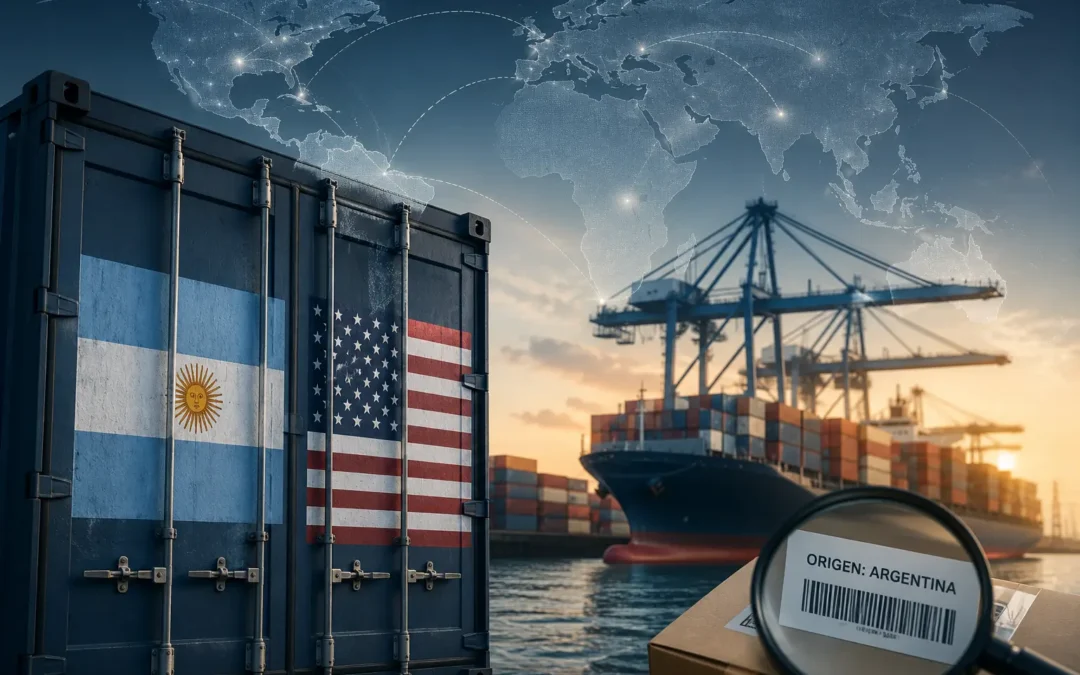
As of July 24, 2026, goods originating in Argentina are subject to an additional 10% duty in the United States. Which products are affected, which are excluded, and what should you check? Argentine exporter.
What happened to Argentine exports to the United States?
On July 23, 2026, U.S. Trade Representative Ambassador Jamieson Greer took final action under Section 301 of the Trade Act of 1974, imposing an additional duty of 101% or 12.51% on goods originating from sixty trading partners, including Argentina, which together account for 99.41% of U.S. imports. The measure took effect at 12:01 a.m. EST on July 24, 2026. The justification given is the failure of these economies to impose and effectively enforce a prohibition on the importation of goods produced with forced labor.
The measure replaces the general tariff under Section 122 (10%) that had been in effect since February 24th, and whose 150-day statutory period was set to expire on July 24th. For exporters already operating under that system, the nominal tariff rate remains unchanged. What changes, substantially, is the legal basis: Section 301 has no expiration date, relies on an investigative procedure with prior hearings and consultations, and is therefore much more resistant to legal challenge. It is advisable to abandon the expectation that this is a temporary situation.
Why was Argentina subject to the 10% tariff?
The Trade Representative established three tiers. 12.5% for most of the economies surveyed. An intermediate tier of 10%, or 12.5% net of the most-favored-nation rate, for certain products from the European Union, Taiwan, Japan, Korea, and Switzerland. And 10% for a group of seventeen economies including Argentina, Bangladesh, Cambodia, Canada, Ecuador, El Salvador, Guatemala, Honduras, India, Indonesia, Jordan, Malaysia, Mexico, Pakistan, Sri Lanka, Trinidad and Tobago, and the United Kingdom. Argentina thus fell to the lowest tier of the new scheme.
That lower tier was granted to countries that already have a legal prohibition on importing goods produced with forced labor, or that have a partial regime with that effect, or that have committed to establishing one through a Reciprocal Trade Agreement. Argentina entered through this last route. We do not have a prohibition of that nature in our legislation: the benefit comes from Reciprocal Trade and Investment Agreement signed with the United States on February 5 of this year, the framework of which had been announced in November 2025.
This has a commercial interpretation that matters more than the legal one. The 2.5-point differential compared to those paying 12.5% is not yet finalized: it rests on a commitment that Argentina made but has not yet implemented through regulations, and on an agreement that, as of the date of this publication, has not yet been approved by the Congress of either country.
Which Argentine goods are affected?
The law applies to most imports originating from the countries covered.
Which products are excluded from the additional tariff?
Informational materials, donations, and accompanied baggage are excluded. Also excluded are all articles and parts subject to Section 232 duties—steel, aluminum, and their derivatives—so there will be no overlapping duties on those items.
There are also five product exclusion categories: raw materials whose taxation could compromise the availability of supply in the United States; products likely to generate widespread economic disruptions; goods that cannot be grown or produced there in sufficient quantities or at reasonable prices or obtained from other sources; items for which the duty would not substantially contribute to the objective of the measure; and a fifth category that deserves special attention.
This fifth category comprises products that are excluded with the express purpose of incentivizing compliance with the commitments made, and the Trade Representative specifically identified Argentina among the beneficiary economies, along with Bangladesh, Cambodia, Ecuador, El Salvador, the European Union, Guatemala, Indonesia, Jordan, Malaysia, Switzerland, Taiwan, and the United Kingdom. Therefore, there are Argentine goods exempt from the additional duty precisely because of the February Agreement. Which ones they are, can be found in the annexes of the Federal Register Notice of Final Action, which detail the exclusions by item in the Harmonized Tariff Schedule.
Does the agreement with the United States exempt us from the new tariff?
It is important to clear up a potentially costly misunderstanding. The February Agreement contains concessions in favor of Argentina—including the expansion of preferential access for beef and the U.S. commitment to favorably consider the Agreement's impact when adopting measures under Section 232—but none of these concessions exempts Argentina from the additional duty under Section 301. They are distinct instruments with independent legal foundations: the fact that a product is included in the Agreement does not mean it is exempt from the new tariff.
The only way in which Argentine merchandise is exempt from 10% is if its position is expressly listed in the exclusion annexes of the final action of July 23, or if it is an item covered by Section 232. Outside of these two cases, the law applies.
What should an Argentine exporter check?
Verification is done position by position. It is advisable to identify the Harmonized Tariff Schedule heading for each exported product, confirm whether or not it appears in the exclusion annexes, and only then determine the effective import duty. Working by product family or general assumptions leads to errors, because the exclusions were defined by heading and not by sector—this is part of the type of regulatory and commercial risk analysis which should be addressed before making delivery or price commitments to a US buyer.
In commercial transactions, the duty is paid by the US importer, who will typically pass on part of the cost. It is necessary to review ongoing transactions to determine who assumes the import duties as agreed, whether there are adjustment mechanisms in place for regulatory changes, and to assess the impact of the duty on the agreed prices.
Finally, exporters of products currently listed in the exclusion annexes should bear in mind that this exemption is contingent upon Argentina's compliance with its commitments. This is the part of the table that is beyond the exporter's control, but it is still worth monitoring. The fishing sector provides a good example of the specific nature of this analysis: during the public comment period, Argentina had requested the exclusion of shellfish and frozen fish, and the USTR rejected this request—no product in Chapter 3 of the tariff schedule was exempted.
The final action of July 23, 2026 can be found directly in the press release. Office of the United States Trade Representative (USTR) and in his official fact sheet. The pre-publication version of the Federal Register Notice, with all attachments, has been available on the USTR website since July 23; the official paginated version is published at federalregister.gov. For specific operational details—which subheading of Chapter 99 to declare—the source is the CSMS messages from Customs and Border Protection.
MJE Global Advises companies on foreign trade and market entry strategies between Argentina and the United States, focusing on customs compliance, tariff classification, and export logistics.
Does your company export to the United States?
Tariff classification and the identification of applicable exclusions are crucial for understanding the actual impact of new measures. MJE Global assists Argentine companies with the regulatory and strategic analysis of their international operations.
Andrea Zavatto
Consultant in Foreign Trade Strategy | Trade Compliance & Regulatory Affairs
MJE Global LLC — MJE Foreign Trade. Learn more about the team.
On August 13, 2026, Peter Navarro, Trump's advisor and White House trade and manufacturing policy chief, published an opinion piece in the New York Times that begins with a very specific image: a recliner "made in Vietnam" that actually contains a Chinese motor, finished and packaged in China, which is simply bolted on at a Vietnamese plant before being shipped to Norfolk, Virginia. If the documentation holds up, that "Made in Vietnam" label eliminates 25 percentage points of tariffs the product would otherwise pay. Rules of origin, traceability of inputs, and interpretive trickery.
That day, the White House released the full report, "The Great Transshipment Scam," from the Office of Trade and Manufacturing Policy. The 25-page document identifies more than 40 countries as part of a "transshipment network" that allows Chinese exporters to circumvent U.S. tariffs through minimal processing, relabeling, and document alterations. Argentina is on that list.
For any company operating in the Argentina-United States corridor, this document is not just a footnote. It's a fairly clear snapshot of how Washington thinks today, and why it should be taken seriously, regardless of the good relationship between their presidents.
What does the report say, in plain English?
The document's logic is simple and repeated on almost every page: every import that replaces a US-made product takes jobs away from American industry. And beyond the uncollected tariffs, they argue, the erosion of that industrial capacity leaves the country vulnerable in disruptive scenarios (a pandemic, a war, a supply chain disruption) where having the money to buy isn't enough; you need someone to manufacture.
Based on this, the report classifies the more than 40 countries mentioned into three levels, not by political proximity but by scale of trade linked to China and by the type of "advantage" they offer for rerouting: volume (Canada, the EU, Mexico, South Korea, Taiwan), deep productive integration with Chinese chains (Brazil, Vietnam, Malaysia, Thailand, Turkey, Indonesia), or smaller countries with specific vulnerabilities such as cheap labor, free zones, bonded warehouses, low customs control (this is the case of Argentina, grouped together with Chile, Peru, Colombia, Costa Rica and twenty other countries of this third level).
Table 1. The three levels of the transshipment network (according to the report)
Tier
Label
Criterion
Countries
Tier 1
Diversified scale leaders
Large absolute volumes of goods linked to China; diversified industrial bases and relevant export platforms to the US, where the transshipment risk is embedded in broad legitimate trade flows.
Canada, European Union, India, Israel, Japan, Mexico, South Korea, Taiwan
Tier 2
Leaders of scale with significant economic integration with China
Significant transshipment volumes combined with deeper integration into supply chains linked to China: inputs, manufacturing platforms, logistics systems, or regional rerouting channels.
Brazil, Indonesia, Malaysia, Thailand, Türkiye, Vietnam
Tier 3
Small and opportunistic Chinese targets
Smaller economies with lower absolute transshipment volumes, but with specific advantages—cheap labor, free trade zones, port or border access, bonded warehouses, niche assembly capacity, preferential access to the US, or low customs enforcement capacity—that make them attractive targets for opportunistic rerouting linked to China.
Argentina, Azerbaijan, Bangladesh, Cambodia, Chile, Colombia, Costa Rica, Dominican Republic, Georgia, Jordan, Kazakhstan, Kenya, Laos, Morocco, Myanmar, Oman, Panama, Peru, Philippines, Singapore, Sri Lanka, Switzerland, United Arab Emirates, Uzbekistan
It's interesting to note that the classification doesn't distinguish based on ideological affinity with Washington. Argentina, currently one of the governments most rhetorically aligned with the Trump administration in all of Latin America, appears in the same risk category (Tier 3) as any other country offering a free trade zone or a permissive customs policy. The report measures the flow of goods linked to China, not bilateral relations. Therein lies a first lesson: friendship between presidents doesn't exempt a country from tariff scrutiny or the negative categorization of its institutions based on their concrete results.
This report does not appear in a vacuum: it is based on the same framework of Section 301 of the Trade Act of 1974 under which, since July 24, 2026, Argentina has already been paying an additional tariff of 10% on its exports to the United States—the minimum within the new scheme, thanks to the Reciprocal Trade and Investment Agreement signed in February. For full details of this measure and what Argentine exporters should review, see: The United States applies a new 10% tariff to Argentine exports.
But the document has a second, more detailed table that should be examined before drawing hasty conclusions. There, the report doesn't group countries by scale but rather by the functional role they play within the network used to conceal Chinese products.
Argentina, along with Brazil, Chile, Colombia, and Peru, is part of the "Latin American Corridors" cluster, whose function is described as Pacific-Atlantic rerouting, use of bonded warehouses, and regional assembly. This is a significant distinction: unlike other clusters in the same report, what the document attributes to Argentina is essentially geographical and logistical: its geographic location and its foreign trade infrastructure. This difference is important when understanding what kind of scrutiny to expect: less focus on internal controls, and more on the traceability of inputs used to assign Argentine origin to goods exported to the United States.
Table 2. Functional architecture of the transshipment network (according to the report)
Functional cluster
central role
Illustrative countries
Micro-hubs of Southeast Asia
Light assembly, export processing zones, relabeling and re-export of goods linked to China
Bangladesh, Cambodia, Laos, Philippines, Sri Lanka
Central and Eastern European Processing Belt
EU-based termination, contract manufacturing, bonded warehouses, and regional relabeling
Czech Republic, Hungary, Poland, Romania
Maritime Gateways
Re-export from free trade zone, deep-water port handover, container consolidation and re-invoicing
Costa Rica, Dominican Republic, Malaysia, Oman, Panama, UAE
Belt and Road land nodes
Rail and dry port transit, land-to-sea consolidation and transfer
Azerbaijan, Georgia, Kazakhstan, Uzbekistan
Latin American corridors
Pacific-Atlantic rerouting, bonded warehouses and regional assembly
Argentina, Brazil, Chile, Colombia, Peru
African peripheral hubs
Emerging port and free zone facilities for select flows linked to China
Kenya, Morocco
Developed logistics platforms
Advanced customs, ports, trading houses, bonded warehouses and global re-export systems
Belgium, Canada, Netherlands, Singapore, Switzerland, Türkiye
Brazil's case is a good reflection of this same idea, but with its own nuances. Brazil appears in the report as a Tier 2 supplier due to its productive integration with China, at a different risk level than Argentina. At the same time, Brazil has become the country where US tariff policy is most openly intertwined with domestic politics: the 501 TPS tariffs imposed in 2025 were explicitly presented by the White House as a response to the impeachment proceedings against Jair Bolsonaro for the 2022 coup attempt; the additional 251 TPS tariffs in July 2026 stemmed from a broader USTR investigation into unfair trade practices (the PIX payment system, Brazilian tariffs on ethanol, deforestation), which nevertheless includes among its justifications the judicial censorship attributed to the judge who convicted Bolsonaro.
Brazil will elect a president on October 4, 2026, with Lula seeking reelection against Flávio Bolsonaro, son of the former president (barred from holding office until 2030 and imprisoned since 2025), the Liberal Party candidate with Trump's explicit backing. It would be reasonable to expect that a potential victory for Bolsonaro would resolve the tariff dispute. But the most interesting fact, at the time of writing, is that the candidate himself asked Washington to pause the new tariffs before the election, because polls show they are costing him votes: what should be ideological support is being interpreted, on the Brazilian street, as foreign interference that ultimately benefits Lula. Even for the US government, the equation "political affinity = favorable trade treatment" is not as straightforward or predictable as it first appears.
This is not a new policy, although it is being intensified today.
An important distinction is worth noting, because it's often lost in the discussion: Section 301 tariffs against China are not an invention of Trump's second term. They were imposed in 2018, during his first term, and the Biden administration, far from dismantling them, left them almost intact. Moreover, in 2024, it selectively expanded them to include electric vehicles, semiconductors, batteries, and Chinese steel. In other words, with regard specifically to China, there is a six-year continuity between administrations of opposing political persuasions.
What is new in 2025-2026 is the escalation toward differentiated and reciprocal tariffs applied to the rest of the world. Added to this is the specific pursuit of a "transshipment network" that would use third countries (including Argentina) to help China circumvent tariffs. This shift is indeed characteristic of the second Trump administration.
What does this mean for those planning for the medium term? It means that this policy shouldn't be viewed as a one-term whim. Protectionism toward China has persisted through two consecutive administrations, of different political persuasions, without being dismantled. It wouldn't be surprising (although this is an interpretation, not a certainty) if the next government, regardless of its political leanings, maintains much of the current framework. If that's the case, the relevant question for a company isn't "Will this change with the next election?" but rather "How do I design my operations to function effectively under this paradigm, however long it lasts?"«
The contrast that cannot be ignored
This is where the tension that motivates this article comes in. While Washington declares its manufacturing industry strategic and builds an artificial intelligence architecture—the so-called "Detective Border"—to track the true origin of each shipment, Argentina has been moving in the opposite direction: lowering tariffs and tariff protection for its industry in general, while promoting mining investments with exceptional tax breaks and, in several cases, without the obligation to repatriate export earnings, a benefit not available to the rest of Argentina's productive sector.
This isn't about judging whether one policy or the other is right. Trump protects his entire manufacturing industry, declaring it strategic and adopting decisions consistent with his assessment. Argentina, on the other hand, is betting on attracting capital for the development of specific sectors that will eventually yield results in the medium and long term, relying on exceptional tax and exchange rate rules, while simultaneously dismantling tariff and non-tariff barriers protecting its overall manufacturing industry. These are legitimate decisions by two sovereign nations. The point is that they are moving in opposite directions, and a company operating between the two cannot plan as if both economies were moving in sync. They are moving in tension, and strategy and action must be adapted to this reality.
What this means in practice
None of these generalities apply across the board to the entire tariff system. Exporting steel to the United States is not the same as exporting soybeans, meat, or lithium. Each sector has its own specific characteristics: specific tariffs, exposure to AD/CVD (antidumping and countervailing duties, which in some Chinese products exceed 3,001 TP3T cumulatively), applicable rules of origin, and now, additionally, the reputational risk of being flagged on a map like this if the value chain includes Chinese inputs or components at any stage.
Against this backdrop of a profound shift in the multilateral paradigm, every company that exports to or imports from Argentina to the United States needs to review two things: its actual integration into the global supply chain—where its inputs come from, what percentage of added value is genuinely local, and how defensible its tariff classification and declared origin are—and its forward deployment strategy, knowing that the bar for control from the U.S. side will be raised, not lowered. This review process is precisely what we at MJE Global work on with our clients.
MJE Global Advises companies on foreign trade and market entry strategies between Argentina and the United States, focusing on customs compliance, tariff classification, and export logistics.
Does your company export to the United States?
Understanding how your supply chain risk is classified and what evidence of origin and traceability you can provide in the event of customs inspections are now central to a sound export strategy. MJE Global assists Argentine companies with the regulatory and strategic analysis of their international operations.