
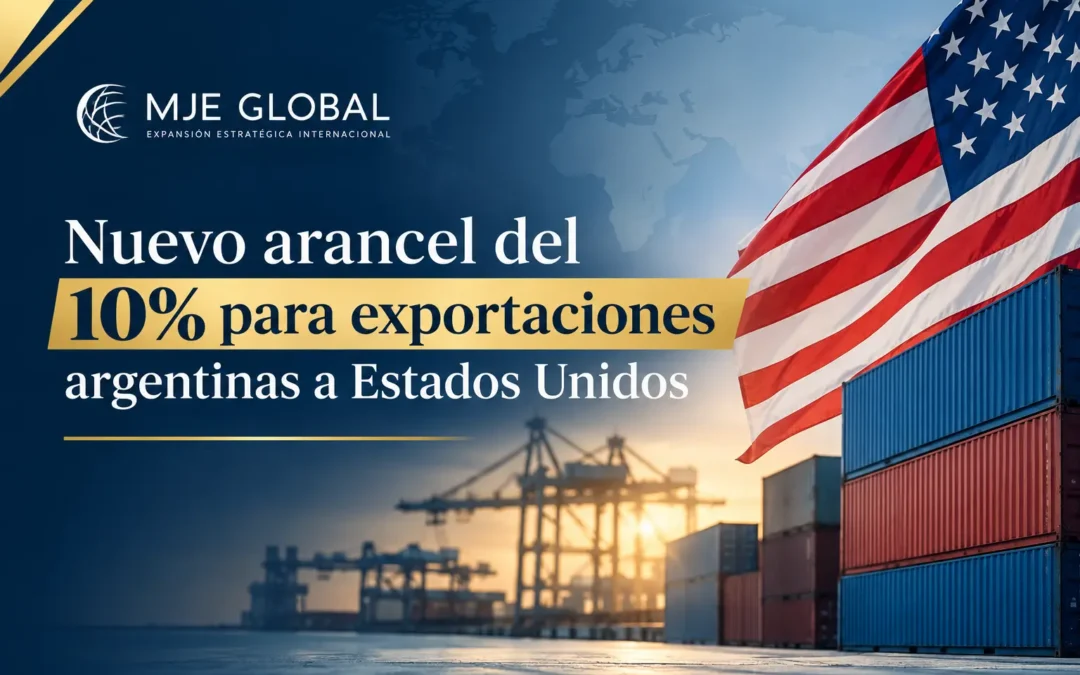
The United States applies a new 10% tariff to Argentine exports
By Andrea Zavatto — MJE Global
A version of this analysis was originally published by Andrea Zavatto on LinkedIn, for the Argentine American Chamber of Commerce of Florida (AACC), on July 24, 2026.
As of July 24, 2026, goods originating in Argentina are subject to an additional 10% duty in the United States. Which products are affected, which are excluded, and what should you check? Argentine exporter.
What happened to Argentine exports to the United States?
On July 23, 2026, U.S. Trade Representative Ambassador Jamieson Greer took final action under Section 301 of the Trade Act of 1974, imposing an additional duty of 101% or 12.51% on goods originating from sixty trading partners, including Argentina, which together account for 99.41% of U.S. imports. The measure took effect at 12:01 a.m. EST on July 24, 2026. The justification given is the failure of these economies to impose and effectively enforce a prohibition on the importation of goods produced with forced labor.
The measure replaces the general tariff under Section 122 (10%) that had been in effect since February 24th, and whose 150-day statutory period was set to expire on July 24th. For exporters already operating under that system, the nominal tariff rate remains unchanged. What changes, substantially, is the legal basis: Section 301 has no expiration date, relies on an investigative procedure with prior hearings and consultations, and is therefore much more resistant to legal challenge. It is advisable to abandon the expectation that this is a temporary situation.
Why was Argentina subject to the 10% tariff?
The Trade Representative established three tiers. 12.5% for most of the economies surveyed. An intermediate tier of 10%, or 12.5% net of the most-favored-nation rate, for certain products from the European Union, Taiwan, Japan, Korea, and Switzerland. And 10% for a group of seventeen economies including Argentina, Bangladesh, Cambodia, Canada, Ecuador, El Salvador, Guatemala, Honduras, India, Indonesia, Jordan, Malaysia, Mexico, Pakistan, Sri Lanka, Trinidad and Tobago, and the United Kingdom. Argentina thus fell to the lowest tier of the new scheme.
That lower tier was granted to countries that already have a legal prohibition on importing goods produced with forced labor, or that have a partial regime with that effect, or that have committed to establishing one through a Reciprocal Trade Agreement. Argentina entered through this last route. We do not have a prohibition of that nature in our legislation: the benefit comes from Reciprocal Trade and Investment Agreement signed with the United States on February 5 of this year, the framework of which had been announced in November 2025.
This has a commercial interpretation that matters more than the legal one. The 2.5-point differential compared to those paying 12.5% is not yet finalized: it rests on a commitment that Argentina made but has not yet implemented through regulations, and on an agreement that, as of the date of this publication, has not yet been approved by the Congress of either country.
Which Argentine goods are affected?
The law applies to most imports originating from the countries covered.
Which products are excluded from the additional tariff?
Informational materials, donations, and accompanied baggage are excluded. Also excluded are all articles and parts subject to Section 232 duties—steel, aluminum, and their derivatives—so there will be no overlapping duties on those items.
There are also five product exclusion categories: raw materials whose taxation could compromise the availability of supply in the United States; products likely to generate widespread economic disruptions; goods that cannot be grown or produced there in sufficient quantities or at reasonable prices or obtained from other sources; items for which the duty would not substantially contribute to the objective of the measure; and a fifth category that deserves special attention.
This fifth category comprises products that are excluded with the express purpose of incentivizing compliance with the commitments made, and the Trade Representative specifically identified Argentina among the beneficiary economies, along with Bangladesh, Cambodia, Ecuador, El Salvador, the European Union, Guatemala, Indonesia, Jordan, Malaysia, Switzerland, Taiwan, and the United Kingdom. Therefore, there are Argentine goods exempt from the additional duty precisely because of the February Agreement. Which ones they are, can be found in the annexes of the Federal Register Notice of Final Action, which detail the exclusions by item in the Harmonized Tariff Schedule.
Does the agreement with the United States exempt us from the new tariff?
It is important to clear up a potentially costly misunderstanding. The February Agreement contains concessions in favor of Argentina—including the expansion of preferential access for beef and the U.S. commitment to favorably consider the Agreement's impact when adopting measures under Section 232—but none of these concessions exempts Argentina from the additional duty under Section 301. They are distinct instruments with independent legal foundations: the fact that a product is included in the Agreement does not mean it is exempt from the new tariff.
The only way in which Argentine merchandise is exempt from 10% is if its position is expressly listed in the exclusion annexes of the final action of July 23, or if it is an item covered by Section 232. Outside of these two cases, the law applies.
What should an Argentine exporter check?
Verification is done position by position. It is advisable to identify the Harmonized Tariff Schedule heading for each exported product, confirm whether or not it appears in the exclusion annexes, and only then determine the effective import duty. Working by product family or general assumptions leads to errors, because the exclusions were defined by heading and not by sector—this is part of the type of regulatory and commercial risk analysis which should be addressed before making delivery or price commitments to a US buyer.
In commercial transactions, the duty is paid by the US importer, who will typically pass on part of the cost. It is necessary to review ongoing transactions to determine who assumes the import duties as agreed, whether there are adjustment mechanisms in place for regulatory changes, and to assess the impact of the duty on the agreed prices.
Finally, exporters of products currently listed in the exclusion annexes should bear in mind that this exemption is contingent upon Argentina's compliance with its commitments. This is the part of the table that is beyond the exporter's control, but it is still worth monitoring. The fishing sector provides a good example of the specific nature of this analysis: during the public comment period, Argentina had requested the exclusion of shellfish and frozen fish, and the USTR rejected this request—no product in Chapter 3 of the tariff schedule was exempted.
This same Section 301 framework is also the basis for the recent White House report, "The Great Transshipment Scam," which places Argentina among the countries at risk for transshipment of Chinese goods. For those who wish to delve deeper into this aspect, you can read our analysis: Washington ranked 40 countries for risk of "Chinese transshipment." This is how Argentina was positioned..
Official sources and applicable regulations
The final action of July 23, 2026 can be found directly in the press release. Office of the United States Trade Representative (USTR) and in his official fact sheet. The pre-publication version of the Federal Register Notice, with all attachments, has been available on the USTR website since July 23; the official paginated version is published at federalregister.gov. For specific operational details—which subheading of Chapter 99 to declare—the source is the CSMS messages from Customs and Border Protection.
MJE Global Advises companies on foreign trade and market entry strategies between Argentina and the United States, focusing on customs compliance, tariff classification, and export logistics.
Does your company export to the United States?
Tariff classification and the identification of applicable exclusions are crucial for understanding the actual impact of new measures. MJE Global assists Argentine companies with the regulatory and strategic analysis of their international operations.
Andrea Zavatto
Consultant in Foreign Trade Strategy | Trade Compliance & Regulatory Affairs
MJE Global LLC — MJE Foreign Trade. Learn more about the team.