
This article was originally published in Mercojuris September 27, 2026. We share here textual fragments of the article.
On September 22, 2026, the first day of the General Debate of the United Nations General Assembly, various speeches offered a particularly stark picture of the tensions permeating the international order. António Guterres described a world of “fractured markets and weakened institutions” and posed the choice between a power governed by law and one dominated by force and coercion. Emmanuel Macron asked whether we want to live under a kind of “law of the jungle” or in an international society organized by rules. Luiz Inácio Lula da Silva spoke of a UN whose credibility is weakened by inaction and contrasted multilateralism with unilateralism. Donald Trump, from a different perspective, championed action as the response to ineffectiveness: “While others talked, I acted,” and later, “While others promised force, I used it.”.
The point here is not to decide which of these political views is correct. The relevant question is: are these differences the cause of the crisis in the international system, or merely its most visible manifestation? Perhaps the crisis of the United Nations is the tip of a much deeper iceberg, built upon experiences of ineffectiveness, inequality, frustration, and loss of trust that occur earlier, within each society.
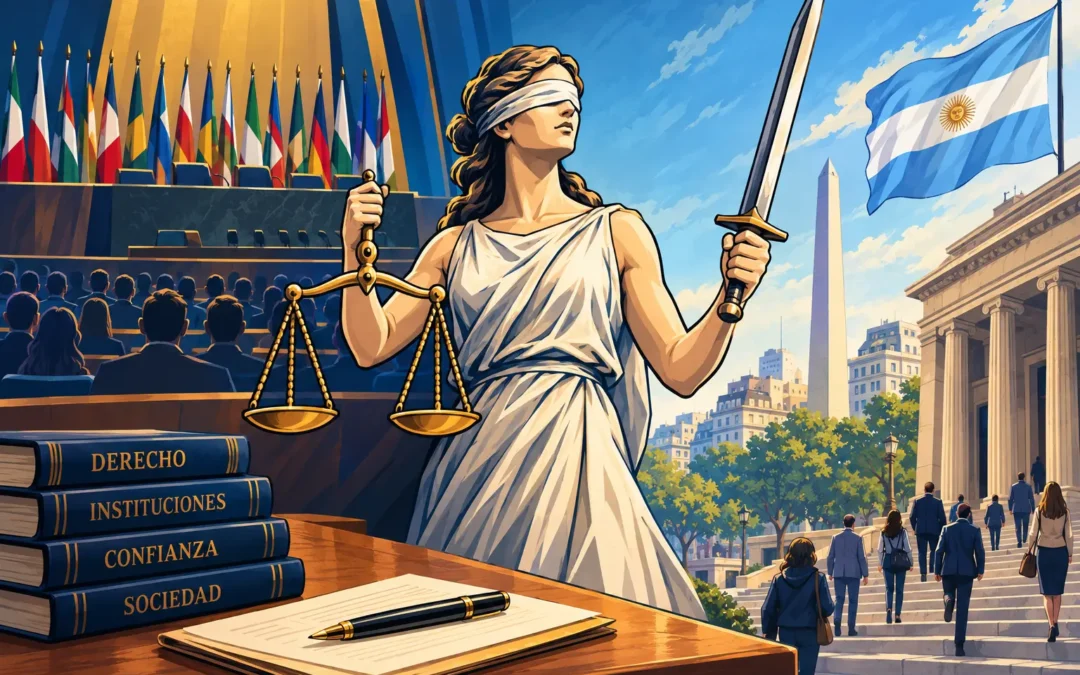
Over 150 years ago, Rudolf von Ihering offered an image that remains remarkably relevant today. Justice, he wrote, holds in one hand the scales with which to weigh the law and, in the other, the sword that serves to enforce it. “The sword without the scales is brute force, and the scales without the sword is law in its impotence.” For Ihering, therefore, law and force are not necessarily opposing terms. The crucial question is who wields that force, under what rules, and in the service of what law.
[…]
But the conflict doesn't disappear when the institutional response fails. If someone repeatedly finds that resorting to the law doesn't produce an effective solution, the need to defend what they consider theirs remains. When the institutional intermediary loses its effectiveness, the temptation to take matters into their own hands resurfaces. This can be done by an individual, by a group, and, on another level, as a social demand for authorities capable of “doing” what the institutions seem unable to resolve.
[…]
An unjust response erodes the legitimacy of the system. A response that never comes erodes its effectiveness. Both damage trust. But a prolonged absence of response has a particularly troubling consequence: the conflict doesn't necessarily disappear; it can leave the institutional sphere and seek another means of resolution. Imperfect justice can be corrected. Justice that never comes leaves a void that someone eventually fills.
[…]
That observation allows us to return to New York. Perhaps the speeches delivered before the General Assembly did not originate there. Perhaps they are the international projection of processes that began much earlier: in the daily relationship between citizens and institutions; in the perception of whether rules produce results; in the trust—or distrust—regarding those who must apply them; and, finally, in social preferences for certain ways of exercising power.
[…]
Domestically, at least in theory, the sequence is recognizable: law, judge, decision, law enforcement, compliance. Internationally, this structure is far more incomplete. There are rules, institutions, and courts, but no global law enforcement force equivalent to that which a state can employ within its own territory. The “sword” of international law remains, to a large extent, distributed among and within the states themselves: it is these same states—with their institutions, their temporary governments, and their societies—that must uphold the system.
That is why it may be insufficient to ask ourselves only how to reform the United Nations. We should also ask ourselves what kind of relationship with the law we are building within our own communities. The strength of a rules-based international order can hardly be completely separated from the strength of the legal sentiment of the societies that comprise it.
[…]
Perhaps that's why the crisis we see on the international stage today shouldn't be viewed solely from above. The balance of the United Nations also rests, to some extent, on millions of smaller scales that function—or cease to function—within each society.
Read the full article on Mercojuris
María José Etulain Sórensen is the Founder and CEO of MJE Global and coordinates the Foreign Trade Committee of the Argentine-American Chamber of Commerce of Florida (AACC). She specializes in Customs Law and International Trade, holds an MBA, and is currently pursuing a Master's degree in Logistics and Supply Chain Management at Florida International University (FIU).
Sources: Rudolf von Ihering, The Struggle for Law. Speeches before the 81st session of the United Nations General Assembly, 22 September 2026.