
Air or sea freight between Argentina and the United States: when paying more is the right decision
In international logistics, choosing the mode of transport is not a budget decision — it is a strategic decision.
Why is choosing between air and sea freight a strategic decision?
On the Buenos Aires–Miami route, shipping one ton of cargo by sea using LCL (less than container load) can cost between USD 80 and USD 150 per cubic meter, with transit times of 25 to 35 days. The same ton by air costs between USD 3,000 and USD 8,000—but arrives in 2 to 4 days. The decision isn't just about cost: it's about what best protects the company's business objectives.
Comparison of costs and times
| Maritime | Air | |
|---|---|---|
| Time | 25–35 days | 2–4 days |
| Approximate cost. | USD 80–150/m³ | USD 3,000–8,000/ton |
| Ideal for | Bulky loads | Urgent shipments |
When is it advisable to use air transport?
Air freight is justified when:
- The value of the merchandise—or its immediate availability—is high relative to the freight cost: electronics, pharmaceuticals, medical supplies, seasonal fashion items, critical spare parts. In these cases, freight represents a small fraction of the product's value, but delivery speed can mean the difference between capturing or losing a market opportunity.
- The cost of capital tied up for 20 days in transit exceeds the freight difference.
- Out of stock costs more than air freight, or there is a deadline that shipping cannot meet.
Economies of density
In transport economics, economies of scale are achieved when a company grows in size: more routes, more modes of transport, more markets. Economies of density, on the other hand, are generated when a greater volume of cargo is concentrated within the same origin-destination pair and using the same mode of transport, allowing for greater capacity to be used on both the outbound and return journeys.
In air transport, when the cargo transported over the same routes and the same aircraft is optimized to the extreme, the unit cost per kilo transported decreases — and air freight becomes more competitive.
What we observed in Dallas Fort Worth
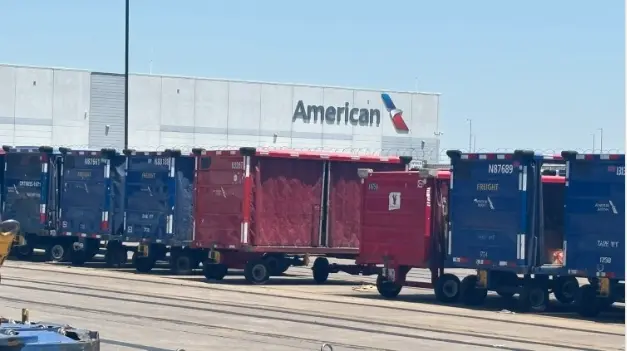
During a visit organized by FIU Chapman Graduate School of Business, access to the operations of American Airlines Cargo, AIT Worldwide Logistics and the Dallas Fort Worth International Airport (DFW) allowed us to observe how these decisions are made in practice: capacity management on narrowbody and widebody aircraft, digitization of cargo bookings, and real-time dashboards that monitor high-priority cargo — from perishables and high-value merchandise to medical cargo.
DFW is no accident that it's a hub. According to Moody's Industry Diversity Index, it ranks among the top five in 10 of the 12 industry sectors surveyed by Site Selection magazine, and holds the top spot in Aerospace. This diversified economic base generates the volume flows—in both directions—that fuel economies of density and enable more competitive fares on a route connecting South America with one of the world's major hubs, offering direct connections to any point in the United States, including Miami.
Conclusion
In a context of reshoring and reconfiguration of global value chains, the question isn't whether air freight is expensive. The question is: what is the cost of not arriving on time?